
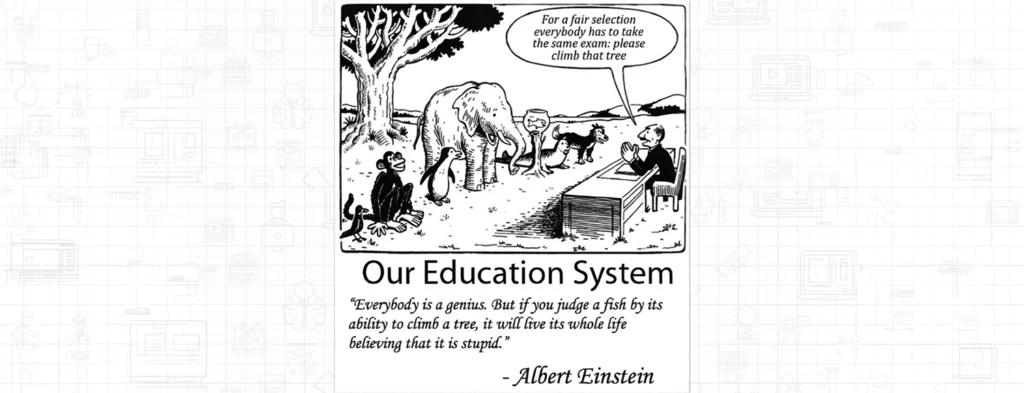
For too long, education reform has focused on fixing the individual—by assessing, ranking, and remediating one child at a time. Decades of exams, report cards, and performance data later, we still grapple with a fundamental question: why do learning outcomes vary so widely, and why does improvement rarely last?
Perhaps we’ve been measuring the wrong thing. The question is not whom we measure, but what we measure. The whom is the school, as a living system, and what is to move the needle from episodic individual level assessment to more continuous competency-based assessment. The shift is not about discarding individual assessment, but about balancing it with collective assessment, which is critical in driving improvement in learning outcomes.
As John I. Goodlad wrote in A Place Called School,
“Efforts at improvement must encompass the school as a system of interacting parts, each affecting the others… The approach having most promise is one that will seek to cultivate the capacity of schools to deal with their own problems, to become largely self-renewing.”
The lesson is simple: schools improve when they learn as systems, not when individuals learn in isolation.
When Systems Learn, Students Thrive
A study of 32 secondary schools in Ethiopia makes this point vividly. Researchers found that high-performing schools were not succeeding because of a few exceptional teachers or students, but because of whole-school quality practices: engaged communities, committed leadership, teacher development, and a culture of continuous learning. These collective strategies showed a statistically significant link to academic achievement. Even in resource-constrained contexts, meaningful change began not with the exceptional few, but with the collective whole.
Every year, millions of students are tested. But how often do we ask what their schools have learned? Or whether the institutions themselves are future-ready? Despite endless data on individual learners, most schools still cannot say with confidence whether their success was by design or by chance.
That is because our assessment lens remains narrowly focused on the individual.
The Limits of Individual-Only Assessment
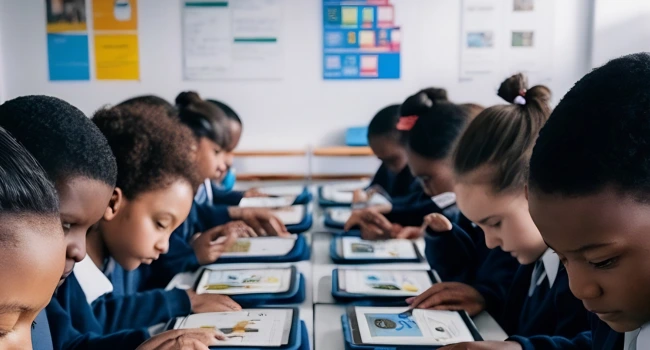
Exams and report cards tell us how well a student performs, but they rarely tell us why. A child’s achievement is shaped not just by effort, but by teaching quality, leadership, infrastructure, and school culture. Yet accountability rests almost entirely on the learner.
India’s National Education Policy (NEP) 2020 recognizes this imbalance. It calls for competency-based and holistic assessment, including initiatives such as the Holistic Progress Card (HPC) developed by PARAKH, a step toward viewing learning as a systemic outcome, not merely a personal one.
In other words, when we measure only the child, we miss the ecosystem that enables the child to learn. To improve learning, we must also measure the conditions that make learning possible.
The Policy Shift Already Underway
Encouragingly, India’s education reforms are beginning to reflect this systemic thinking:
- The Performance Grading Index (PGI) assesses schools and states on teaching quality, infrastructure, and outcomes.
- School Quality Assessment and Accreditation (SQAA) by CBSE examines school-wide practices rather than individual results.
- The National Achievement Survey (NAS) gathers data at school and system levels to inform improvement.
- The Curriculum Reform 2025 shifts focus from marks-centric evaluation to competency-based, formative assessment that tests understanding and real-world application.
Together, these initiatives move India closer to viewing schools as learning organizations. School-level diagnostics reveal whether curriculum, instruction, and assessment align—or operate in silos. It is a form of insight that individual testing alone can never provide.
Globally, the same shift is visible. The OECD’s PISA for Schools offers a school-level version of the international PISA assessment. Instead of ranking students, it helps schools understand their learning environments, teaching practices, and student mindsets against global benchmarks. From Australia to the UK, it has become a mirror for institutional learning—proof that assessment drives progress best when it guides collective reflection, not competition.
Assessment is evolving from a microscope on students to a mirror for schools. The next step is ensuring the shift towards collective assessment takes root culturally, not just bureaucratically.
Why Collective Assessment Matters
Schools are living ecosystems comprised of teachers, students, leaders, and communities working in interdependence. When assessment focuses only on individuals, it fractures incentives: students chase marks, teachers teach to the test, and collaboration becomes optional.
Collective assessment, on the other hand, builds shared accountability, strengthens collaboration, and turns schools into self-improving systems.
By shifting the whom we assess to the school and the what to its systemic practices, we can create institutions that learn continuously, just as we expect their students to.
The New Role of School Leaders
This transformation also redefines school leadership. The principal’s job is no longer to administer exams but to design cultures of learning. With school-level assessment, leaders can pinpoint systemic strengths and gaps across pedagogy, teacher development, student well-being, and community engagement while balancing individual-level assessments simultaneously.
Progressive schools are already using diagnostic tools to examine how teachers collaborate, how curricula evolve, and how learning environments support growth. The goal is not to rank schools but to help them see themselves clearly and act on what they learn.
If the NEP was the call to action, and OECD’s PISA provides the compass, then Excel One’s role is to help schools navigate. The journey ahead is about readiness. Readiness for jobs. Readiness for citizenship. Readiness for a society that is more uncertain, digitized, and interconnected than ever before. For India, embracing a culture of evidence is an investment in the future of the nation. Join us in this Yatra.
The Mindset Shift Ahead
Ultimately, the real reform lies in reprogramming how we think about assessment itself and balancing individual and school-level assessments.
Assessments must become tools for growth, not verdicts of worth. The future belongs to learning communities that know how to reflect, adapt, and evolve together—schools measured by how well they nurture curiosity, collaboration, and well-being.
At Excel One, we believe that when schools learn, everyone wins. That’s why we see tools like PISA for Schools not just as assessments, but as mirrors, helping schools see themselves more clearly. When schools use evidence to reflect on how learning happens, they begin to grow from within. It’s this process of collective learning — by teachers, leaders, and students alike — that drives lasting change.
- December 16, 2025